Search Chicken Scratch Blog

Saturday, July 30, 2016

Cleopatra

Good Morning Chicken Scratch Blog Followers! I apologize it has been so long since my last post. A lot has happened with the girls lately so I have to get to sharing!
About a month ago one of our new hens was being picked on. This is normal when you add new hens to the flock because they have to reestablish the pecking order. Someone will always be the head hen and someone will be at the bottom, it is just how it works. As long as no one is bleeding and for the most part they are getting along then everything is going correctly. However, we had one of our girls that ended up getting pecked a bit too much.
 Cleo is our largest hen. Her growth rate is that of a meat bird, however, she is still an egg layer. Looking at her size you would think that she would be the "boss" of the group but she truly is a gentle giant. The crown still belongs to Betty and Luna, they keep our flock in line.
   At the top of Cleo's tail near her preening gland up towards the middle of her back her feathers had been plucked out. Which then caused her to have a bit of bleeding. It sounds scary but I can assure you she was fine and after we saw her wound she received the royal treatment!
    When you first experience a bird that is hurt it can be a bit overwhelming. Many of you know I have a incredibly soft spot for animals and sympathize with their pain as a lot of people I know do as well. You just have to remember that these things happen and do what you can to make them more comfortable and help the wound stay clean and heal.
Cleo and I hanging out for a few minutes.
  The first thing we did was give Cleo a bath. I wanted to make sure the wound was clean and the area around it was as well. You can do this in a wash sink or a shallow bucket. You fill the sink/bucket with warm water and gently set the bird in. They will fidget at first. Chickens remind me of cats and are not big fans of getting wet. Hold their wings down and lightly keep pressure on the hen and you will feel her relax in the warm water. Of all the chicken baths I have given I have not had a hen yet who did not enjoy the bath after they were warm. I run the water over the hens entire body except for their head. I only spot wash a hens head if necessary with a damp towel.  Then I use an animal friendly shampoo that is usually for sensitive skin so it is not so harsh on the hens. After washing the entire body I rinse the hen thoroughly and wrap her in a towel. We have a towel that is designated for Chickens now so I would keep that separate from your personal towels. I use a blow dryer to finish drying their feathers. Keep it on a low heat and put a good distance between the dryer and feathers so the bird does not get too hot. If you move in a circular motion it drys the feathers faster as it lifts them from the skin to get in between each layer. Once dry they can usually rejoin the flock. This time we do not do that with Cleo because we needed her to heal.
      For a few days I cleaned her wound with Peroxide and put some Neosporin on it to help prevent infection. I applied both parts of this process with a Q-tip.
   We kept her separated from the other birds until her wound scabbed over. She got her own food, bed and waterer. She loved it. We hung out! It was nice because she use to be a little hesitant when we would pick her up. Now, she runs right over to us when we walk in the run and typically follows me around! Such a sweetheart.
  Just to note, you want to keep the bird separated from the other hens until they are healed otherwise the wound will keep being re-opened. Her sisters cannot help but peck out of curiosity. You can keep them in a crate or if you have another coop area you can put the bird in there. We kept Cleo in a crate during this process. It was big enough for her to walk around and stand up so she was comfortable. We put her food and water in there with her along with a small branch that she could roost on at night to sleep.
  Currently she is back in the run and good as new. Her feathers are still missing, however, they will grow back once she goes through her first molt.

Friday, May 27, 2016

Are You My Mother?

Have you ever read the Dr. Seuss book Are You My Mother? That was one of my Dad’s favorite books when we would read the series together when I was a little kid.  It is a good one! The reason I mention that is because we have a broody hen right now and when she started acting like this it reminded me of that story. Broody hens are chickens that believe the eggs that are being laid are fertilized and will become baby chicks. What they do then is nest in the eggs boxes all day and all night laying on top of the eggs keeping them safe and warm. It really is sweet and endearing.
Dumpling, our broody hen, really wants to be a Mama. When we first introduced our new girls to the coop she would chase them around the run. It was not in a territorial mean way. It was as if she wanted to be their mom or friend. Take them under her wing, pun intended.
 This is my first experience dealing with a broody hen so I was not sure of what to expect. Right now what Dumpling will do is roll all of the eggs into a pile and then lay on top of them all fluffed up. She will continuously do this all day and night. Each day I have been taking her out of the egg box so at least I know she is getting food and water at some point each day.  Once she has ate a meal she heads back in to the egg box to continue her duty of protecting the eggs. This is right after she takes a dirt bath of course. She has been keeping herself extra clean lately. Rushing over to the dirt bath, scrubbing up and then heading back inside.

I also have noticed that she has pulled the feathers from her stomach out. I read online that hens will do this so they have skin to egg contact to help keep the eggs extra warm. They also have been known to use the feathers to create a comfortable nest for the eggs to rest on. It is not a painful process for the hens and once the hens molts new feathers will grow in anyway.
Her characteristics through this process have also changed. She makes a “cooing” sound every night when Cory or I go and retrieve the eggs for the day. Almost asking us to not touch them please. However, even after removal of the eggs she still remains nesting in the egg box.  Broody Hens will continue to protect the eggs even if they are not there; “ghost eggs.” You could buy fake eggs at your local tractor supply store if you want to give her something to lay on.
When she does come out of the coop she makes a loud unique squawking noise every so often and flaps her wings, pushes out her chest and fluffs up her feathers. I am not too sure what is means when she does this. I am assuming it is something to do with the broodiness but she sounds a bit dramatic which makes it comical! Haha.
I also do not know the timeline of how long this will go on for. I have read its upwards of 20 days until the eggs hatch. Which in our case, they never will. Other flocksters have suggested removing broody hens from the egg box repeatedly until they break the cycle or putting them into a separate container with a wire bottom so they are not comfortable and break the trance. I just do not have the heart to do that. Something in her brain is telling her right now that she is a mother. That is nature’s way and I am not one to ruin the natural cycle.  Egg production from that hen will go down so you could test out those methods to break the broodiness and have her start laying again but we are going to let it play out. So Dumpling, enjoy being a Mother Hen!


Saturday, March 5, 2016

Welcome Home!


Ding Ding Ding.. Round Two!! Last night Cory and I picked up eight little chicks from Runnings so I wanted to give my readers a quick update. We are SO excited to be adding to our brood. Our Chicken family is growing! We ended up getting three different breeds this time; all of which we do not currently have in our flock. We purchased four Rhode Islands Reds, two California Whites, and two Rainbows. I cannot get over how tiny they are. I forget that our "OG" (original girls) were that small at one point! When they walk onto your hands it feels like a little tickle as do their pecks. So sweet! I even had one girl fall asleep in my hands! I love when that happens.
All of these breeds are known to be great layers so we have some delicious eggs coming our way in the future.
  The first night they were getting use to being in the brooder together. We got them set up with their heat lamp, waterer and food. We needed to purchase Chick Starter feed. The feed is typically medicated to help build up the immune systems of the baby chicks and it is made out of mostly crumbles that way it is easier for them to eat. I let them eat out of my hand this morning so they get use to being handled. We did this with our year old hens and now they are comfortable with us being around and picking them up.
  We purchased a new waterer this year as well. It works just like the one we currently have for the hens. It is gravity fed the difference is that it is teeny tiny! They look adorable drinking out of it.
  My heart is so full right now knowing we are adding these little girls to the group! I was like a little kid on Christmas morning I was so excited. I'll keep you all updated as these little ones grown. I am going to be one busy chicken mama over the next few weeks making sure these girls stay healthy and grow up strong so they can be added to the coop. Their sisters are excited to meet them as well.. I hope! :)


Tuesday, March 1, 2016

Peep Peep


Chick Days has finally arrived! Who will be starting or adding to their brood? I know we will be adding some new tiny girls to our group!


Thursday, February 11, 2016

Tweet Tweet

The blog is now on Twitter!! Check us out and Follow our page! Tweet us any questions you have or let us know what you would like to read about next!! See you there!!

Tuesday, February 9, 2016

The Hunt for a Chicken Waterer


I wanted to share some small but very good news with my fellow readers. We finally found a waterer that works! Wahoo! Since we got the eight little hens we have been struggling to find a watering system that would be care free and provide enough water that all eight hens have the opportunity to drink at the same time.

The first one we tried was a gravity fed galvanized 3 gallon waterer. But the gravity feed on it was not working properly so the water just kept spilling over the edge until the waterer was empty and the bedding became soaked. Back to the store that went. The next two we tried were both plastic waterers, also 3 gallon I believe. The first one the handle broke off which is what controls the gravity feed. The second one the ring around the top that seals the lid snapped. Back to the store those two went as well. In between all of the returns and frustration we used a regular glass bowl in the brooder box for the chicks and when they were bigger switched over to a Tupperware tub (This is what you are seeing in the video at the top of the page). The glass bowl when they were chicks we also placed and even smaller bowl in the center to take up some of the space to prevent drowning. Chicks are not as equipped as hens to get out of water as easily and we wanted to prevent anyone for being harmed. With the Tupperware tub, this was large enough that several hens could drink at the same time in the coop and we raised it up a bit on some stones for easier access. The only big downside to these two options was we had to change the water every single day. They are not closed off watering systems and sometimes bedding would get in there or the girls would tip them over and we would have to clean up and refill. I did not mind doing this in the spring and summer because we had our garden hose right next to the coop and we could just fill it up each time. However, once winter came, it was a whole different ball game.
 Now I cannot complain too much because this winter so far has been relatively mild. However, we have had some freezing temperatures which led to frozen water in the coop. As I have mentioned in previous posts, water is essential to the hens health especially in the winter because they are consuming more food to keep warm hence they drink more water. We would have to break the ice up or dump it out and pour fresh water in. It was okay at first, but if the water in the bowl was frozen then that usually means the water in the hose was also frozen. Not the easiest task to accomplish. We would have to go inside the house fill up the waterer and bring it back out, sometimes multiple times a day depending on the weather. I really did not mind doing this for the little ladies but it was becoming quite the chore.

  This was all until Cory found the best waterer!! It is a tall skinny plastic electric waterer!! Electric!! It holds 3 gallons of water and has a plug that you just hook up to an extension cord or however you want to get power to it and boom you are done. No freezing water and no changing it every day! It is a beautiful thing! Haha. We set this up on top of a milk crate in the coop to keep it higher to make it easier for the hens to drink out of but also to keep the bedding out of it. When the hens scratch they tend to make quiet a mess and so you want to make sure their water is always clean. The waterer also has an internal thermostat so it only runs when it is beginning to get below freezing otherwise it will shut itself off! We have had it for a few months or so now and have had no complaints yet (fingers crossed). 

Wednesday, December 23, 2015

Winter Wonderland

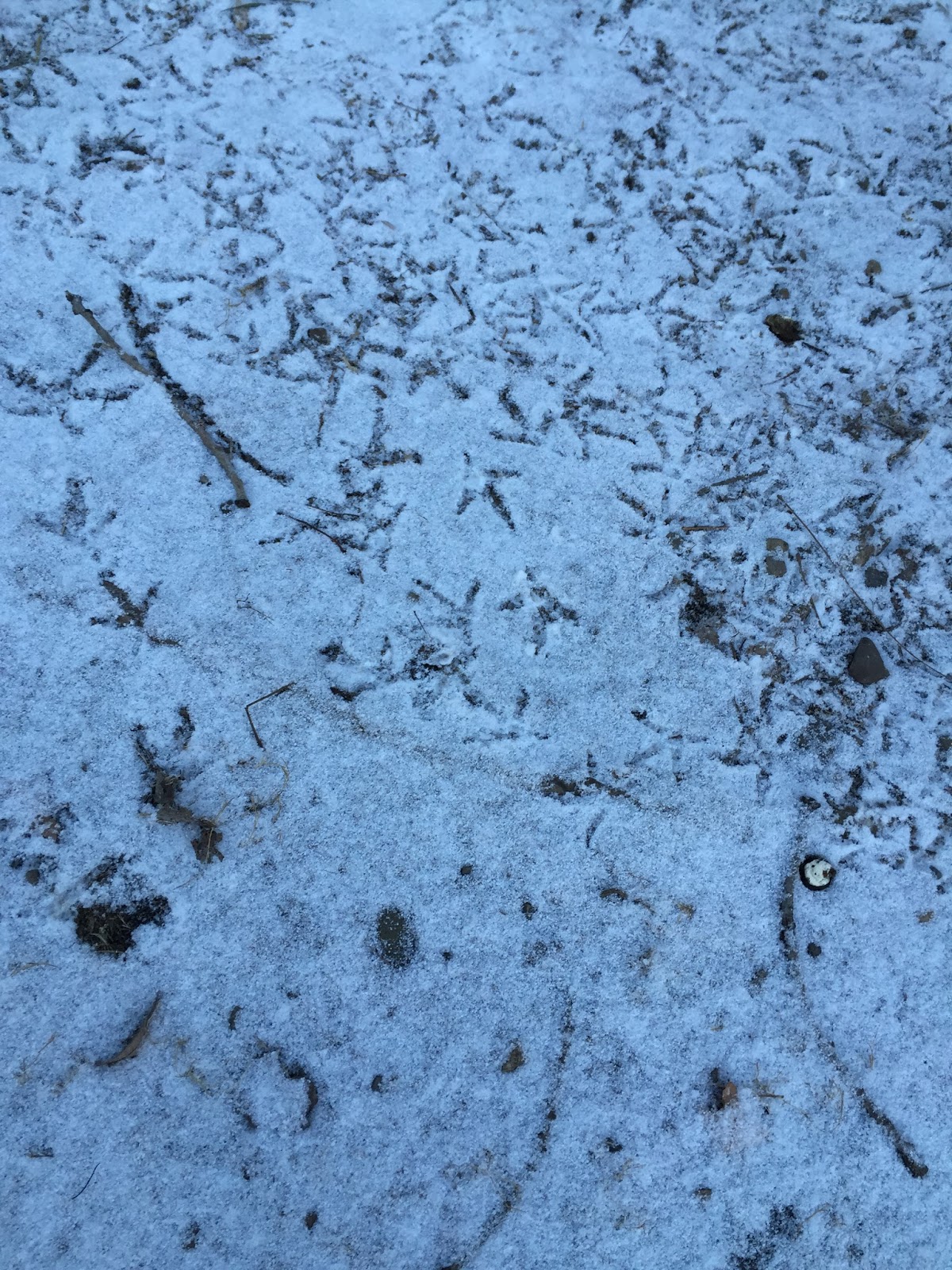
Footprints in the first snowfall
This winter season is really throwing me for a loop this year. I was anticipating heavy snow, bone-chilling temperatures and a battle between us and mother nature. So far, we had one soft snowy day and it did not even stick to the ground. Don't get me wrong, I am totally happy not having to shovel my car out of the snow, but I was prepared to help our little hens tackle the winter.
   This is our first winter with the girls and so I wanted to make sure we were ready for the challenge. I did a lot of research in preparation of the colder months to understand the do's and don'ts for chicken keeping.
    Chickens are known for not being huge fans of snow. When we did have the one day of light snow fall the girls went outside and looked a little confused. They kept picking their tiny feet up and pecking the ground trying to understand what this cold white stuff was. Since we have been lucky without having a large amount of snow yet we haven't had to worry about the run as much. A few ideas of what to do when it does snow is you can cover the snow with some straw for the chickens to walk on. If the snow becomes deep, you will probably have to shovel an area for them to peck around and free range. If you have a smaller run, I have read other owners covered their run with a tarp to keep the snow off the ground. Our run is more of a larger fenced in area so we will be picking up our shovels and make a path for the ladies.
    Our coop is pretty much squared away since we are already doing the deep little method that adds extra insulation to keep the hens warm. You will want to make sure there is no draft in the coop. Chickens are able to sustain pretty cold temperatures by huddling together. It is easier for them to get warm in the winter with their natural down coats than to cool down in the summer. However, too much wind can cause the chickens to get frostbite and sick. If the wind is too much in the coop you can tarp the outside. It is important to make sure your coop has great ventilation since the hens might spend some more time inside than they normally do. If you see a build up of condensation on your coop windows, that means you do not have enough ventilation and need to come up with a way to get better air circulation.
Water is the enemy in colder months. It is sort of a catch twenty-two when it comes to water. You need to keep the coop as dry as possible to keep the hens healthy, yet you need to make sure the hens always have access to drinking water. The reason being, hens consume more food in the winter to keep their bodies warm and in turn drink more water. Water freezes. You can get a heated bowl that plugs in and keep the water at an above freezing temperature. Or you can make several trips from the inside to the outside changing out the frozen water for fresh water. (which we have been doing since the temps have been above freezing most nights). Another idea I read about is placing a ping pong ball in the water to keep the water in constant motion to prevent freezing. I have not tried that one yet!
 It is not recommended to insulate your coop. This can cause humidity and ammonia levels to increase which can cause your hens to become ill. If you purchase hearty birds they are built to handle colder temperatures. The only thing I would keep an eye on is their feet, wattles and combs to make sure they are not getting frostbite. These are areas of their bodies where they release heat. Our White Leghorns have larger combs so they are more susceptible to frostbite than our other hens since the combs are farther away from their bodies. To be proactive in preventing frostbit you can put petroleum jelly on these body parts to give them a layer of protection.
 Do not be surprised if your egg production decreases a little bit. The hens go through an adjustment with the season changes and sometimes they do not lay as frequently. They are getting use to temperature changes and the fact that in the winter it gets darker earlier. Hens usually need 12 hours of daylight to lay productively. Some owners place supplemental light in the coop to keep production up. We decided we are not going to do that only because we are not dependent on having the large volume of eggs. They will lay when they lay! Also, you will want to collect your eggs more frequently to prevent them from freezing. Adding straw to the egg boxes helps for a little bit of extra insulation.  Lastly, the hens wanted to celebrate the holiday season too so we added some lights to the outside of the coop! We turn them off at "bed time" so they can get some rest. It is a fun and festive way to jazz up the outside of the coop.

Happy Holidays and Merry Christmas!!